Reliability Of BISP Data For Electricity Subsidies: Question Arises!
The Benazir Income Support Program (BISP) holds data on millions of people who are in need and require financial assistance from the government. This has made it easier for many organizations to reach and support targeted individuals. It also ensures that the families receiving assistance through the 8171 BISP Program are truly eligible and deserving. Therefore, the government has announced that starting in 2027, only those who are part of the BISP Program will be eligible to receive subsidies on electricity bills.
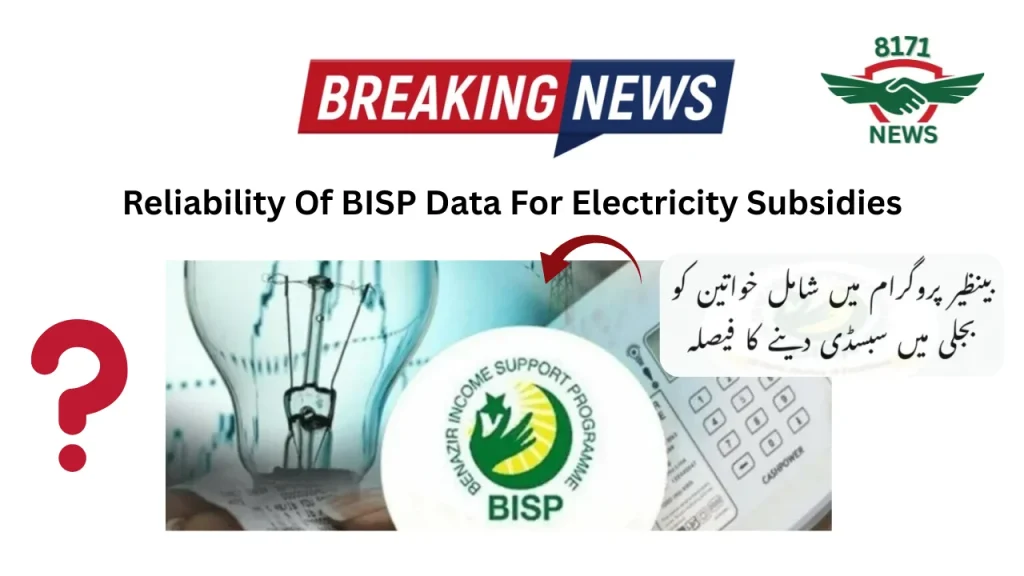
However, Sardar Awais Ahmed Khan Leghari, the federal minister of power, questioned Tuesday the veracity of the Benazir Income Support Programme (BISP) statistics used to assess who is eligible for electricity subsidies.
Leghari Questions BISP Data Accuracy as Power Subsidy Reforms Loom
The Minister underlined the necessity of reforms to guarantee that subsidies are allocated to worthy consumers while speaking at a meeting of the NA Standing Committee on Power, which was presided over by MNA Muhammad Idrees.
In response to MNA Rana Muhammad Hayat, Leghari disclosed that 180 million of the 380 million people who use electricity use up to 200 units per month, a number that is increasing by over 4 million users per year. He emphasized that the 80% subsidized cost for these “protected” users is the lowest in the area. He did warn, though, that a large number of consumers in this group had solar systems installed, which raises the total cost of subsidies.
Also Read: BISP Kafalat 13500 Double Payment Check – Who Will Get 27000 In Cash!
“BISP data contains inconsistencies. Leghari emphasized the government’s initiatives to implement reforms and enhance targeting, saying, “We must make sure subsidies reach truly eligible households.”
Govt Launches App to Curb Overbilling; Rs 500 Billion Lost Annually in Power Sector
Regarding small differences in monthly use, such 200 versus 201 units, the Minister pointed out that a cutoff point needs to be set. In an effort to reduce excessive charging, he added, the Prime Minister has introduced the “Apna Meter, Apni Reading” smartphone app.
In response to a question concerning losses in the power industry, the Minister disclosed that, of the Rs 500 billion in overall losses, Rs 250 billion is caused by electricity theft each year. The non-recovery of invoices is responsible for the remaining half.
He explained that until local authorities request it, electricity cannot be provided to slums or unlawful housing societies (katchi Abadis). He explained that distribution businesses, or discos, are only required to make connections in response to official requests from the appropriate authorities.
Discos Can’t Serve Unregulated Areas Despite Financial Gain: Leghari
Leghari clarified, “Even though providing electricity to informal settlements may benefit discos financially, it ultimately burdens the national exchequer.” We are unable to expand services to unregulated developments, even if higher use can result in lower tariffs.
The Minister affirmed that he had received a response from Sindh Chief Minister Murad Ali Shah to his previous correspondence for the removal of Electricity Duty (ED) from electricity bills as of July 1, 2025. He stated that responses from other provinces are still pending and that the current yearly ED collections are between Rs 60 and Rs 70 billion. He stated, “We will be talking about Sindh’s response at the level of the prime minister.“
Talks Are Underway With The IMF
Leghari added that discussions over subsidized tariffs for the industrial and agricultural sectors are currently taking place with the IMF and development partners.
Discussions regarding HESCO’s discriminatory load-shedding and electricity grid problems in Sanghar were postponed by the Committee. Nonetheless, it went over earlier suggestions and expressed satisfaction with the advancements, such as the attempts to start billing again in 25 villages in Shabqadar, Khyber Pakhtunkhwa.
According to PESCO’s CEO, people of Charsadda are opposed to individual meters and prefer flat charges. After learning of illicit connections, the Committee suggested solar energy systems as a remedy and requested that a subcommittee look into the matter.
Conclusion
While the government plans to use BISP data to offer targeted electricity subsidies starting in 2027, serious concerns have been raised about the accuracy of this data. Minister Leghari emphasized the need for reforms to ensure subsidies truly reach deserving households. With ongoing efforts to reduce power sector losses, address overbilling, and negotiate with global partners, the future of energy subsidies in Pakistan will depend heavily on transparency, accurate data, and better targeting systems.
